


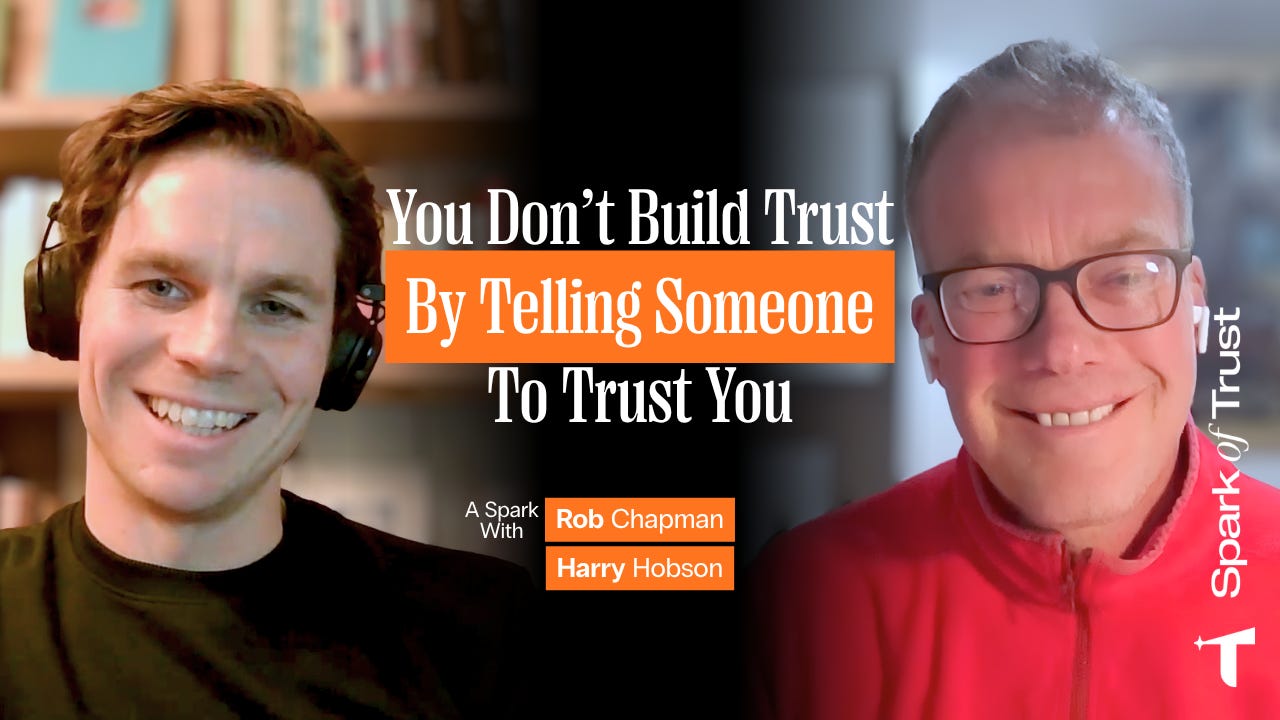
Two of Neya’s founders spent years studying why neighborhoods lose trust, then built a company on the one thing the research kept telling them: you cannot rebuild trust by trying to rebuild trust. You smuggle it in with something else. Make an ordinary, useful thing easy, and let trust accrue as the residue. Here is what that means for anyone trying to build trust, and especially for anyone building technology people are supposed to trust.
Disclosure: I'm an investor in Neya.
Somewhere along the way, you have said the words “trust me” and felt them fall flat in the air. Not because you were untrustworthy, but because trust cannot supply its own evidence. So you take the long way around: the track record, the credentials, the principles published where anyone can read them. But from the outside, the work of being trustworthy and the work of appearing trustworthy can look identical. The person across the table still hesitates.
The hesitation is not a failure of your work. It is a property of trust itself. Trust is the one asset that retreats when you reach for it. Rob Chapman and Harry Hobson have spent years watching this at close range: Harry through Neighbourly Lab, the nonprofit he founded in 2019 to study how neighborhoods connect, after a piece of loneliness ethnography for Facebook moved him enough to quit consulting for big tech altogether; Rob as a serial founder (who sat on Neighbourly Lab’s board while building his own companies) who sold his last company to Accenture1 and then went looking for the problem underneath the problem. Rob’s conclusion is blunt. “To be trusted, you have to start by being trustworthy.” And its uncomfortable corollary: “I don’t think it’s possible to build trust in someone by telling them to trust you.”
If you build technology for a living, you have felt the truth of that sentence: in a pitch meeting, in a customer conversation, in the second a user hovers over a permissions prompt and decides. The question is what to do instead.
Start by lowering the bar. Most conversations about trust set it high: do I trust my bank, do I trust the government, do I trust this platform with my data? Harry is interested in a lower, quieter layer, which he calls “an adequacy of trust…enough trust for other good things to come through.” His plainer phrase for it is the “presumption of good intent”: the unexamined assumption that if you knock on a stranger’s door, you will be met with help. Nobody audits this assumption. Everyday life simply runs on it, the way software runs on an operating system nobody thinks about until it fails.
And it behaves like a threshold, not a dial. Above the line, small cooperation snowballs; people lend things, ask things, notice each other, and each exchange makes the next one cheaper. Below it, everything inverts. “If you live in a place which has got no trust,” Harry says, “life is costly. Everything’s more difficult…You live in a much narrower, more expensive way, a bit like being a tourist in a city you don’t know.” He means costly literally: you buy what you could have borrowed, you pay the market for what neighbors once did for each other, and the isolation compounds into a health cost that longevity startups spend fortunes trying to buy back.2 The summer 2024 riots in a dozen towns across the UK are what the far end of the same slope looks like: a place dipping below the presumption of good intent, under pressure, all at once.
The threshold also explains why local trust is not a small subject. “If you don’t trust people who live outside your door,” Rob asks, “how can you trust anyone who’s on telly or running the government?” Institutional trust is built on a foundation it did not pour.
So how do you raise a thing that recoils from direct attention? Harry’s answer, from years of interventions that worked and interventions that didn’t: “It’s best when it’s smuggled in with something else.” Rob completes the thought: “You build trust through it being smuggled in by doing things you need to do anyway.” Ask people what would make their lives easier, and nobody says trust. Nobody says cohesion. They say childcare, a borrowed drill, help moving a sofa, advice about schools. The method is to meet those stated needs obliquely and let trust arrive as a by-product.
The clearest picture of this involves no technology at all. It is a garden. Neighbourly Lab evaluated a horticulture program for military veterans carrying trauma, people whose trust in the world around them had genuinely broken. Nobody there runs trust exercises. The rebuilding happens “very slowly, very gently, but by doing something oblique”: two people digging, “shoulder to shoulder,” and “just kind of slowly, gradually just noticing each other, realizing that they’re okay.” The urbanist Jane Jacobs3 saw the same mechanism on city sidewalks sixty years earlier, trust formed from “many, many little public sidewalk contacts,” each one done for some other reason, trivial alone, decisive in sum.
If you left the attention economy to build something better, you already know half of this. You know the refusals: no dark patterns, no engagement bait, no surveillance monetization. The oblique method is the other half, the constructive half. It says the path to being trusted is not a louder statement of your values but a quieter product: find the thing people already want done, make it genuinely easy, and accept that trust compounds on its own schedule. Or as Rob puts it, “you can only build community at the pace of trust.”
Which brings us to the awkward part. Rob and Harry’s company, Neya, uses AI to rebuild neighborhood connection, at a moment when the prevailing story is that AI will finish off whatever human connection the feed left standing. “One of the biggest risks for us as a company,” Rob says, “is that we get too excited about AI and what AI can do.” They are candid that the technology does not automatically earn trust: “Where people lose trust is where there’s like an uncanny valley where the AI has done something you didn’t expect or before you were ready.” An introduction made too early destroys the thing it was meant to create.
The discipline runs through the business model. “If the business model is about attention,” Rob says, “then you have to do the things that maximize attention. You need more shocking content, and you need to try and get people hooked into the platform.” Neya charges a local business a fee only when the connection the user requested is successfully made. The incentive is usefulness, not time on the app. And the cost of that choice is on the table too: “we’d rather build more slowly, grow more slowly where people really trust it... than go really fast.” That is a founder, out loud, declining short-term growth his more extractive peers treat as the be-all and end-all.
The early evidence is modest and real: around 450 people testing the product pre-launch, by the founders’ count; a 2025 William Sutton Prize win; and a pilot with Clarion, the UK’s biggest social landlord, which provides homes for around 360,000 people.4 Not a triumph story. A build story, with the bill attached.
The whole argument scales down to something you can do before Friday, no tool or budget required. Rob’s version: “Smiling’s a good start.” In Paris, a former journalist named Patrick Bernard set himself the task of saying hello to everyone he passed; it grew into the Replique Des Hyper Voisins, thousands of neighbors remaking their corner of the 14th arrondissement, starting from a greeting.5 So this week, say hello first. To a neighbor. Or to the one user you have been treating as a metric. Do it for its own sake, and let it be trivial. The “seemingly trivial interactions,” to paraphrase Jacobs, are the mechanism that underwrites our ability to depend on one another in times of need.6
If this named something you have felt, the full conversation goes further: the research behind the threshold, the numbers behind the build, and the failures the founders put on the table unprompted. It starts with Part I of A Spark With Rob Chapman & Harry Hobson, where this essay began. Part II, available next week, discusses their ambition for the work, a phrase worth ending on, because it captures the whole field in a single sentence: “the ability to live a good common local life together.”
Accenture, “Accenture Acquires Founders Intelligence to Help Corporate Executives Drive Growth from Innovation,” November 16, 2021.
Julianne Holt-Lunstad, Timothy B. Smith, and J. Bradley Layton, “Social Relationships and Mortality Risk: A Meta-analytic Review,” PLOS Medicine 7, no. 7 (2010): e1000316.
Jane Jacobs, The Death and Life of Great American Cities (New York: Random House, 1961).
Clarion Housing Group, “Innovation in the Spotlight as William Sutton Prize Winners Announced,” September 29, 2025; Clarion Housing Group, “New AI App Pilot to Help Thousands of Oxfordshire Residents Strengthen Community Connections,” April 9, 2026; Clarion Housing Group, “Peter Kyle MP Unveils Blue Plaque in Hove after Local Resident’s Quest to Honour Social Housing Pioneer,” May 20, 2026.
Denis Cosnard, “Les Hyper Voisins, un laboratoire de l’action de proximité à Paris très courtisé,” Le Monde, November 21, 2019; Lucile Mettetal and Marion Tillet, with Patrick Bernard, “Les Hyper Voisins, ou quand la convivialité renforce la résilience,” L’Institut Paris Region, November 9, 2021.
Jacobs, The Death and Life of Great American Cities. The passage reads: “Most of it is ostensibly utterly trivial, but the sum is not trivial at all … a web of public respect and trust, and a resource in time of personal or neighborhood need.” The phrase “seemingly trivial interactions” follows Neighbourly Lab’s reading of this passage: “Jane Jacobs and the Importance of the Seemingly Trivial Neighbourhood Interactions,” Neighbourly Lab, https://www.neighbourlylab.com/jane-jacobs-and-the-importance-of-the-seemingly-trivial-neighbourhood-interactions/.