


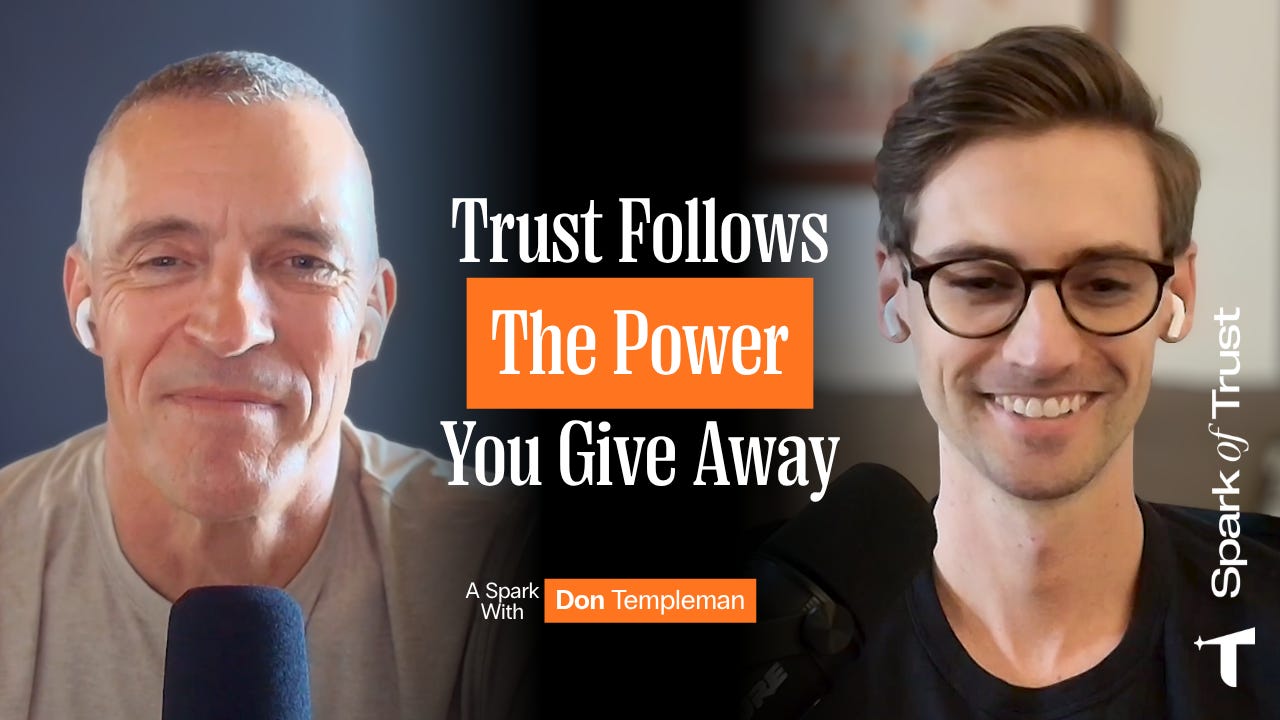
Don Templeman left a six-year finance career to build Aemula, a platform for independent journalism designed so that the company holds none of the writing on its own servers, cannot block a payment, cannot remove a writer, cannot tune the ranking, and cannot tilt what readers see toward one side of politics or the other. Each of those is a power he could have kept. He gave them away because a promise not to use them would never be believed, and because a system that cannot be abused needs no one’s word.
Disclosure: I connected this publication to Aemula, so the essay you are reading is also syndicated to Don’s platform; I did that because I want it to work. I have been an informal advisor to Don, one founder to another.
Don Templeman raised the objection before I could. An hour into our conversation, with the payments and the ranking still ahead of us, he stopped to say the thing a listener would already be thinking: “I do think it’s completely fair, especially on a podcast about trust. How do you trust this technology?” His platform runs on Ethereum. He knows how that lands for most people.
Take the technology out and the question is one every builder has faced: why should I trust you? Most of us answer it the same way. We publish principles. We point at a track record. We say, in one form or another, that we will not do the thing our position lets us do: sell the data, change the rules, put a thumb on the scale. The promise is sincere, and it is worth almost nothing, because the person hearing it has heard it before, from companies that kept it right up until the quarter they didn’t. A promise is a claim about the future, made by the one party with a stake in breaking it.
Don’s answer is not a promise. It is a list of the things he can no longer do.
He did not come to the problem from journalism. In 2016 he was at Wake Forest, studying finance and computer science and running the business side of the student newspaper, which meant paying a roster of independent contributors by the piece. Ethereum had launched the year before.1 He tried to build the thing then and found the network far too expensive to run, so he shelved it with a condition attached: “I told myself, if it ever becomes possible at some point in the future and no one else is doing it and this is still a major problem, then I’ll leave whatever I’m doing at that time and start to work on this again. I didn’t expect that to be six and a half years deep into a finance career.” When the roadmap for a cheaper network firmed up, he says, “I started every month or so checking to see if anyone else was working on something similar,” hoping each time to find someone. “Please someone else go do this so I don’t have to quit my job.” No one did. He left wealth management in February 2024, most recently at ICONIQ Capital, to build it on his own savings. By his account, the network update that arrived a month later made it roughly a million times cheaper to operate than it was in 2016, the number he had been waiting for.
The finance years shaped what he built more than the newspaper did. Investment management, as he describes it, is the daily work of separating what everyone collectively believes from what is true, being handed opposite convictions on the same afternoon, and arguing each caller back toward the consensus. It leaves you with no illusions about being unbiased and a strong interest in systems that do not require anyone to be. He brings that to media. A newsroom’s original product was being the trusted intermediary that made sense of the world for you, verifying what happened where you could not see and packaging it so you did not have to; that trust was the moat, and when distribution went free, the intermediary had to find something else to sell. What it found was the trust itself. Once the money came from advertisers and the metric was attention, the pull was toward whatever kept an audience engaged and agreeing, and a newsroom that once earned trust by standing between you and the world began spending it to hold onto you. Don’s phrase for this is that trust wasn't lost, it was sold. Either way, the fix cannot be a more trustworthy intermediary. His answer is to build trust into the network rather than the institution: “once you build trust into the network itself, you don’t really need to rely on those intermediaries that introduce all of those other centralization problems and audience capture problems.”
Which is where the list starts.
He does not hold the work. “We don’t want to be the ones hosting the information. We don’t want to be the ones holding the content. We don’t want to be the ones serving the content to people. We want the creator of it to actually own the content itself.” A writer’s articles are not on Aemula’s servers waiting for Aemula’s good behavior. They are the writer’s.
He cannot remove anyone. “We can’t go out and shadow ban someone. We can’t remove someone’s account.” Moderation exists, but he is not the moderator: “It’s up to people who have elected to become a moderator, who’ve been trusted as a moderator, have built credibility as making accurate judgment decisions on what should be removed, so that we’re not the ones centrally controlling that process.” The judges are elected; they carry a reputation that a bad call costs them, and the company is not on the bench.
He cannot touch the money. This is the part he came from finance to solve, and the part that took him a year. A subscriber pays ten dollars in ordinary dollars and never sees a wallet; his design test, he says, was “can I send this to my mom, who has definitely not set up a crypto wallet in the past?” Behind the checkout, the dollars become a dollar-backed token in a community-governed pool, and as readers read, the money flows to the writers they are reading. Dollars in, dollars out, with nobody holding them in the middle. As he puts it, “it falls back down directly to you without anyone having full control over that process in the middle of it.” And then, in one breath, most of the list: “We want people to have the confidence to know that when they publish, they independently own their content, when they get paid, it’s coming directly from a subscriber that has read and interacted with their work. We can’t step in and block the payment. We can’t turn people’s monetization off.”
He does not own the ranking. The algorithm that decides what a reader sees is, in his words, “fully open source and fully transparent and it’s community governed.” He draws a distinction here that most companies announcing an open-source algorithm skip. “I’ve always said our algorithm’s human-readable.” Open code that nobody but a specialist can follow is transparency in name; an algorithm that routes its decisions through a large language model is open and opaque at once. “Any transparency you build, if it’s kind of clouded by complexity, it’s not gonna be used.” Aemula’s ranking is a weighted combination of three factors, summarized in a sentence: how recent the piece is, the writer’s track record, and how the community has responded to it. The platform even presents the ranking as a map you can walk around, so you can see why you are being shown what you are being shown without reading a line of code.
Every entry on this list is an answer to the same question. Why should I trust you? You should not have to.
Then comes the entry that is of a different kind. The map is a real thing: readers and writers plotted in three dimensions by who supports whom, with communities of agreement forming as clusters, and the ranking rewarding a writer whose work draws support from clusters that don't usually agree over a writer who draws a thousand cheers from one corner. The obvious way to build such a map is to label it. This cluster leans left, that one right. Don refused, and nothing else he said in two hours cuts as cleanly. “We don’t want any ability to introduce bias.” A labeled map enables weighting, and once weighting is possible, somebody has to trust him not to. “If we say we don’t actually know which is which, then there’s no real way for us to be able to do it.” So the platform knows the shape of disagreement and declines to learn its content: “we know who agrees with whom, we don’t know what their ideologies are.” He calls it verified neutrality, and it is not a power he gave away. It is a power he refused to pick up by refusing to hold the information that would have handed it to him.
It is worth being precise about what the map is for, because a reader will assume it is meant to herd people to the middle. He heads that off. “We don’t want to try to pull everyone into the center. That’s not the end goal here.” What the ranking is built to prevent is drift: “We more just want to avoid pulling people closer to the fringes or pulling people further apart.” He pictures the whole enterprise as the bar room and the library. Social media is the bar, and he means that kindly; it is where you go to argue with your friends. His complaint is that it has also become where people go to find out what happened, and a bar is a poor library.
Now, this list raises a question for anyone who does not run a news platform, which is nearly everyone reading this. The question is not whether you would abuse the power you hold over the people who use what you built. It is the power you hold right now that you ask those people to trust you not to abuse: the admin override; the data you collect, because it might be useful someday; the pricing you can change unilaterally; the account you can suspend. Every one of them is an answer to “why should I trust you” that consists of your word. The harder question, the one Don’s map poses, is which of them you could give away, and which you could decline to know in the first place. That question has an answer for your product. I am not going to guess it.
And here the list runs out, because he has a last line he hasn't crossed off. “We are still in beta,” he says, and while it is, the governance of the decentralized pieces — the switches that control the rest of the list — still sits with the company. He says his intention is that “once everything’s working correctly, we will release the governance rights to the community.” So, honestly stated: the platform that removes the need to trust the company still asks, today, for one act of trust in the company, on the timing. He is a sole founder two and a half years into a plan built for two: “I need to safely be able to have two years of no income. We’re now two and a half years into it.” The first year was not about the product; “the first year was figuring out how to let people pay us, and then we could start to actually build the platform after that,” because the banks saw a media subscription as a financial product. He admits to “definitely underestimating cold start problems”: “no one is going to care about this when it’s an empty platform, an empty network.” Staying solo bought him time, and it has bought all it can. “I am becoming a productivity bottleneck.” He is hiring for three roles now: community, product design, engineering. And he has made one promise no design can retire: the ordinary founder’s promise that an audience will arrive. Writers are earning money on the platform, he says, and “we don’t want to do them a disservice of not actually giving them the audience that we said would be here.”
The numbers, by Don’s account as of the recording and ultimately verifiable through blockchain transactions: 41 publications, about 530 users, almost eight articles a day last month, and almost $14,000 earned by writers on the platform so far, two and a half years in. The economics, also his: Aemula keeps a 10 percent platform fee; running the decentralized infrastructure has come in around 20 cents on a $10 subscription after a further thousandfold drop in network costs; so a writer sees closer to $9, which he puts at “pushing eighty-nine percent,” against the roughly 87 percent he says a writer keeps on Substack once Stripe’s fees are out. He is careful to say he admires Substack and uses it himself. The point of the numbers is not that they are large. They are small and real, and the bill is attached.
The company’s name is a gift to the argument. It comes from a line in Lucan: “stimulos dedit aemula virtus” — rivalry in excellence spurs them on.2 A platform where writers compete on how broadly they can earn credibility rather than how sharply they can provoke is what that line looks like once it is written into a ranking function.
One thing to do this week, and it is Don’s, not mine. He observes that the country online and the country in person are two different places. He suggests “making a point of talking to someone in your daily life that you run into at the grocery store or something and just having a conversation,” and then noticing, on purpose, that “this is more like what the real world is like.” No app, no budget. Treat it as taking a reading. “The act of depolarization is not trying to get people not to care about politics. It’s trying to get what our politics are to actually reflect what real life is.” The reading you take at the grocery store is the baseline the feed keeps overwriting.
The conversation is in two parts, and this essay lives across both. Part I of A Spark With Don Templeman holds the origin, the eight years of checking, and the first half of the list: the content, the accounts, the money, the moderators.
Part II is the map that refuses to learn which side is which, the bill, and the governance he has not yet handed over. Near the end, I asked what gives him hope, and he answered with the thesis from the other direction. “We know what caused it. We can go back and review what got us to this point. So we know it’s just a design problem. It’s not a fundamental flaw of human nature, I don’t think.” If trust is a design problem, you do not repair it by promising to use the power you hold well. You repair it by designing the power out. Or, as he said a moment later, “If it is a solvable problem and we put enough effort into it, it will get solved. So it’s just a matter of time at this point.”
Until next time, keep being the spark that ignites the Trust Revolution.
Stephan Tual, "Ethereum Launches," Ethereum Foundation Blog, July 30, 2015, https://blog.ethereum.org/2015/07/30/ethereum-launches.
Lucan, Pharsalia (De Bello Civili) 1.120: stimulos dedit aemula virtus. The English rendering, "rivalry in excellence spurs them on," is Aemula’s own, at https://www.aemula.com/about.
I appreciate the invite onto the podcast! Always a fun conversation