


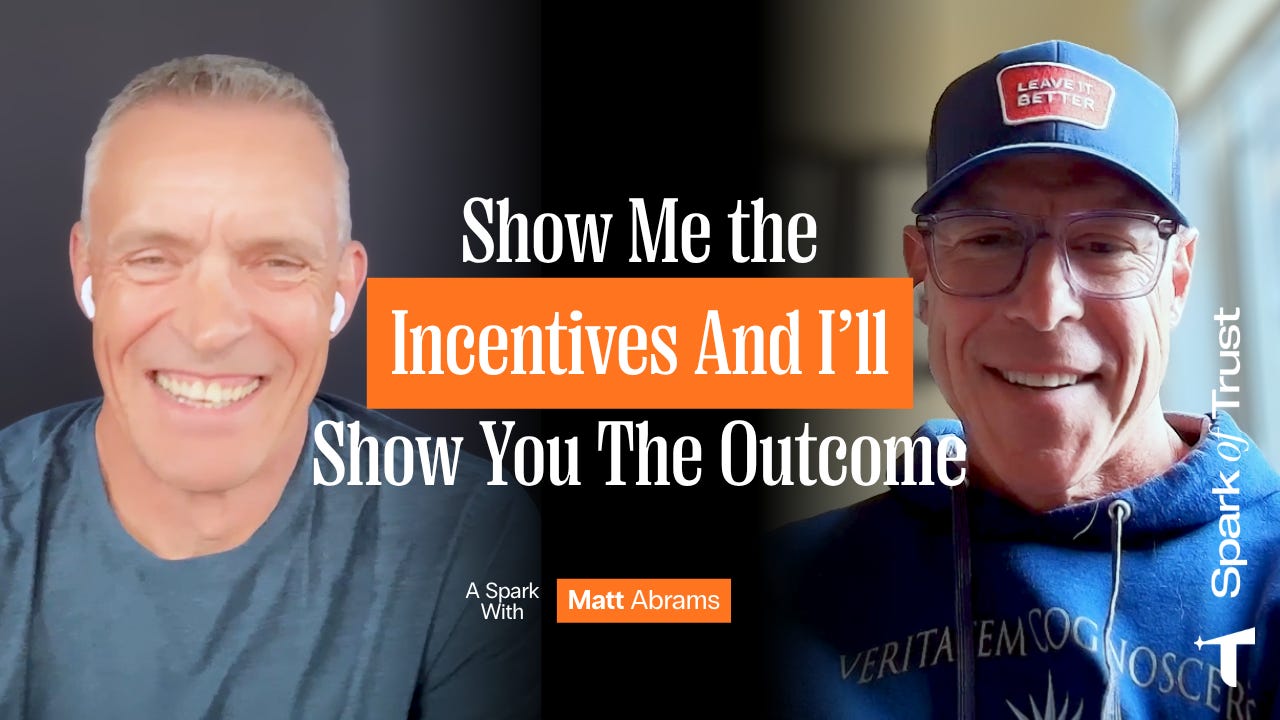
Matt Abrams grew up in an Oregon lumber town watching loggers and environmentalists get pitted against each other while the real story went untold. He became a technologist, a founder, and a venture investor, and he came out the other side convinced that the trust crisis is not a mystery or a moral failing. It is a funding model. And a funding model, unlike a moral failing, can be redesigned: by the people who build, by the people who back them, and by anyone deciding where their attention and dollars go.
Disclosure: Matt is a friend, and his $1 Billion for Trust organization and this show are fellow travelers. I've sat in on their working calls; we often compare notes.
In the fall of 2024, in a Central Oregon county that sits on the dividing line of the Greater Idaho movement, with a militia not far up the road, thirty strangers spent two weekends deciding what their community should do about youth homelessness.1 They had been chosen by lottery from close to 13,000 invitations sent out by local civic organizers, with written commitments from the city council and county commission to consider whatever came back.2 The thirty were a statistically representative slice of the county, paid properly, travel and childcare covered, so that “representative” meant something. Matt Abrams calls the format “jury duty for civic issues.” He watched people who walked in afraid of one another come together to produce 22 supermajority recommendations.3 Six months later, the organizers brought the members back and measured the changes that had occurred between them. “The trust between the assembly members was way up there.”
Assemblies are slow, human, and hard to shortcut. “They’re not efficient,” Matt concedes. “But holy hell are they effective.”
During the assembly, visitors came up from Silicon Valley. That is Matt’s own world; he has spent his career in tech and venture capital, as a founder and a fund partner. One of them surveyed the thing and said, “This is great. This is awesome. How do we get this cheaper?”
Matt’s reaction, on the record and repeated for emphasis: “Fuck you.” Then the sentence that explains the response: “We will put $4 million into a pre-seed stage startup for charlatan X, for promise Y, and yet for a solution that we know solves for trust and provides that core infrastructure that we need for strong economic returns, oh, sorry.”
Here’s some additional context: The assembly took a year of groundwork, led by Josh Burgess, a retired Air Force special-operations colonel who would have earned several times as much doing comparable work at a big tech company.4 The whole thing cost roughly $300,000.5 Local fundraisers in a wealthy county produced about $40,000 of it; the rest had to come from funders and foundations far outside the city and state, because nothing closer existed. The facilitator effectively lives out of his car for half the year; the other half he volunteers in a fire lookout tower. That is the funding reality for a solution that measurably rebuilt trust inside a representative group drawn from a polarized county, in the same economy that will wire millions to a pitch deck by Friday.
That room has a quieter version, and it convenes wherever trustworthy work goes looking for money. You made the product without the dark patterns, the one that charges honestly instead of harvesting attention, and the money across the table was warm and final: impressive, principled, and somehow not a deal. What Matt offers is a way to read that moment correctly. You were not being told your work was weak. You were watching an incentive structure do exactly what it was built to do.
His diagnosis borrows a line you may already use about the attention economy, Charlie Munger’s: “Show me the incentives and I’ll show you the outcome.”6 On the breaking side, everyone can follow it. Social platforms optimize for monthly and daily active users, and, as Matt puts it, “if that’s all you’re optimizing for, then the most provocative, the most extreme things… are gonna be the things which are increasing that engagement.” Nothing about that outcome is surprising. The objective function did what objective functions do.
The move that earns this essay is pointing the same line at the repair side. If trust-building work is starved, erratic, and invisible, that is not because the work is weak. It is because the incentive structure around it optimizes for the wrong thing. “If we get the objective function or functions wrong for what is being optimized for,” Matt says, “then the outcomes are going to be crap.” Read that way, the trust crisis ceases to be a mystery and becomes a failure of resource allocation. And resource-allocation failures are fixable.
Look at what the current allocation actually rewards. Matt calls the money available to trust builders “Oliver Twist funding”: “More porridge, sir, please.” There is no ladder. “We don’t have a rich funding ecosystem like we do across the venture domains… angel, super angel, pre-seed, seed, and on up.” What exists instead is a small number of foundations making project-based grants, gatekeeping included. At the assembly, one organization presented a service for which a grant had paid them to build it but had forbidden them from marketing it. “They couldn’t tell anyone about it, so no one knew about them.” No TechCrunch for the field, no Techstars, no shared playbook. And on the other side of the ledger, for scale: Matt cites Reuters reporting that Meta itself projected roughly 10% of its 2024 revenue, about $16 billion, would come from ads for scams and banned goods.7 Ten percent of one company’s revenue, from fraud, against porridge.
What he refuses, flatly, is the consolation prize of calling any of this charity. Tell a room of investors you run a “social impact” venture and, in his experience, “you get a pat on the head. That’s nice. That’s good of you.” His frame is colder and better: “If you are a blood-sucking capitalist and all you care about is the dollar, then these should be some of the most important investments that you make,” because trust is the infrastructure on which everything else runs, returns included. He points to GPS: taxpayer-built, free at the point of use, and load-bearing for trillions of dollars in private activity. He points to Boeing, a company that optimized shareholder value quarter-to-quarter rather than investing in safety and trust. Had it invested, “they wouldn’t have killed people. Their stock would’ve been cranking.” And he warns that software companies are building their own Boeings.
So he set about building the missing structure. $1 Billion for Trust did not start out as itself. Matt’s first attempt was a conventional venture fund, Democracy Capital, built to pour capital into solutions that build trust across the information environment. It stalled twice over: conversation after conversation went “great idea, but will you change the name?” because the word “democracy” had become polarized; and the fund model itself was, in his words, a “square peg, round hole.” He stopped forcing it. $1 Billion for Trust is what coalesced instead, with others who had arrived at the same conclusion by their own routes, and it is more interesting: a community assembling the three things venture gave software (the capital, the entrepreneurs, and the connective infrastructure between them) for the people rebuilding trust in information, in institutions, and in each other. The number in the name is doing deliberate work. “A billion is still a gnat’s ass in the big scheme of things,” Matt says, against what flows to the solutions that break trust. But a big number announces an investment thesis. A small one announces a cause.
The near-term work, as of our conversation, is almost embarrassingly simple: making the builders visible to each other and to capital. Monthly “trust talks” put working entrepreneurs in front of the community, like Watch Duty, the nonprofit wildfire app that has become core emergency infrastructure in the American West.8 And the visibility gap holds even when the name behind the work is famous. USAFacts, Steve Ballmer’s (of Microsoft fame) nonprofit, turns government data into plain, opinion-free storytelling; when Matt spoke at an intelligence-community summit of about 300 people and asked who knew it, maybe 5 hands went up.9 That gap, between how load-bearing the work is and how few people have heard of it, is the cheapest part of the whole problem to fix.
None of this comes with proof yet, and Matt does not pretend otherwise. His working thesis on measurement is that trust solutions are anti-VUCA: they reduce volatility, uncertainty, complexity, and ambiguity in people’s lives, and that reduction can be tracked. The assembly’s own follow-up data shows the limits as plainly as the promise. Trust among the members soared. Trust between the members and their government rose slightly, then plateaued. And the risk he names first is not in the market but in the mirror. “It’s a human instinct that people want to get credit,” he says. “It will fail if anyone around is saying, ‘Hey, I’m gonna be the one that’s gonna come in and solve trust.’” A capital thesis whose first covenant is that nobody gets to be the hero: either the most naive idea in venture or the most disciplined. I don’t think it’s naive.
Matt’s own version of what to do this week is much smaller than his capital thesis, and cheaper than anything in it. He wears it on a hat that reads Leave It Better. The instruction underneath is a maxim he borrows and keeps plain: “Just be a decent human being.”10 Not a program, not a pledge, no tool and no budget. One decent act, aimed at one person outside your own bubble, this week. It sounds too small to matter against sixteen billion dollars of fraud ads. That gap between the size of the act and the size of the problem is the whole wager: that decency, unlike outrage, compounds in a direction no objective function is currently paying anyone to build toward.
An essay can hold the thesis; the conversation holds the life around it. The childhood between the loggers and the environmentalists. The criminal court that traded prosecution for twenty minutes of life story. The ten-year picture where civic bonds sit next to municipal ones. Part I of A Spark With Matt Abrams is out now:
Part II, next week, follows the capital thesis all the way down to where Matt lands it. We are living through our own version of the Roaring ‘20s, he says; everything is disrupted at once, and like every S-curve, it will eventually settle. The work is deciding what it settles around: trust “front and center in terms of how it levels out. And that’s our job.”
Until next time, keep being the spark that ignites the Trust Revolution.
DemocracyNext, "Deschutes Civic Assembly on Youth Homelessness," https://www.demnext.org/projects/deschutes-civic-assembly (accessed July 15, 2026).
Healthy Democracy, “More Than 12,000 Deschutes County Households Invited to Help Launch Civic Assembly on Youth Homelessness,” press release, October 30, 2024, https://healthydemocracy.org/press/2024/10/30/more-than-12000-deschutes-county-households-invited-to-help-launch-civic-assembly-on-youth-homelessness/.
George Anders, "Can Ordinary Citizens Solve Our Toughest Problems?," U.S. News & World Report, via Associated Press, December 11, 2024, https://www.usnews.com/news/best-states/oregon/articles/2024-12-11/can-ordinary-citizens-solve-our-toughest-problems.
The Rockefeller Foundation, "A Civic Assembly Considers Youth Homelessness — and Democracy," grantee impact story, https://www.rockefellerfoundation.org/grantee-impact-stories/a-civic-assembly-considers-youth-homelessness-and-democracy/ (accessed July 15, 2026).
The figure is Matt's. The AP feature (see note 3) reports the assembly was "underwritten by more than $250,000 in grants."
The line is widely attributed to Charlie Munger; Matt quotes it as Munger's in Part II of the episode. No verified primary Munger text is cited here.
Jeff Horwitz, "Meta Is Earning a Fortune on a Deluge of Fraudulent Ads, Documents Show," Reuters, November 6, 2025, https://www.reuters.com/investigations/meta-is-earning-fortune-deluge-fraudulent-ads-documents-show-2025-11-06/. Also the source for "sixteen billion dollars of fraud ads" in the closing spark.
Watch Duty, “Real-Time Disaster Intelligence You Can Trust,” https://www.watchduty.org (accessed September 7, 2026).
USAFacts, “Accessible Government Data and Statistics,” https://usafacts.org (accessed September 7, 2026).
Anne Applebaum, "History Will Judge the Complicit," The Atlantic, July/August 2020, https://www.theatlantic.com/magazine/archive/2020/07/trumps-collaborators/612250/. The essay closes with Władysław Bartoszewski's "Warto być przyzwoitym" ("Just try to be decent"); the rendering here is Matt's, from the episode.