


Editor’s note, September 2026: This post has been updated with the most recent survey data from Gallup, Pew Research Center, the General Social Survey, and the Edelman Trust Barometer. The analysis is unchanged.

This is part I of a four-part series exploring the nature of the trust apocalypse and what we can do about it.
“Trust is like the air we breathe — when it’s present, nobody really notices. When it’s absent — everybody notices.”
— Warren Buffett
Over the past several decades, trust — once the unseen glue holding our society together — has steadily eroded. Trust in institutions — government, media organizations, the scientific establishment, the judiciary, academia, health, and organized religion, to name a few — trust in Corporate America, and perhaps more worryingly, trust in each other, have all declined. Multi-decade polls, from Gallup and the Pew Research Center to Edelman’s annual trust surveys, confirm that this is a widespread and enduring trend, not a transient phase.
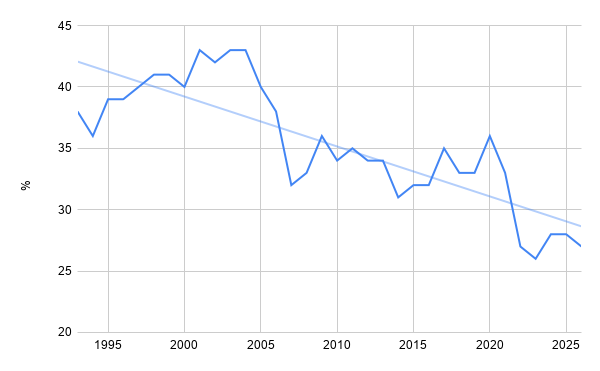
Gallup’s decades-long surveys reveal a steady erosion of trust in the fourteen key institutions (the church or organized religion, the military, the U.S. Supreme Court, banks, the public schools, newspapers, Congress, television news, organized labor, the presidency, the police, the medical system, the criminal justice system, and big business) it has tracked since 1993.1 Average confidence has now sat below 30% for five consecutive years and stands at 27%, with twelve of the fourteen institutions at or near their record lows:
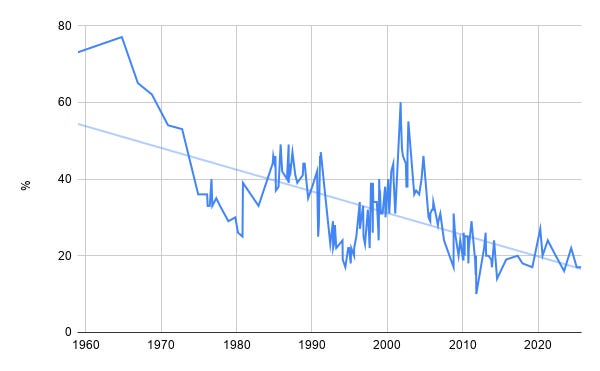
Pew Research Center has asked Americans since 1958 whether they trust the government in Washington to do what is right just about always or most of the time.2 In the early 1960s, roughly 75% said yes; as of 2025, just 17% do — after readings of 16% in 2023 and 22% in 2024, among the lowest measures in nearly seven decades of polling:
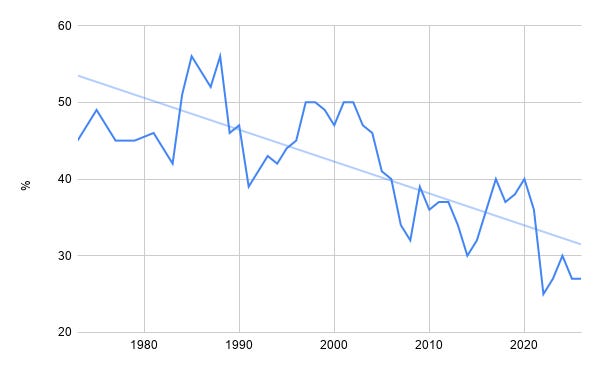
Even the historically venerated Supreme Court has seen an erosion of trust over recent decades:3
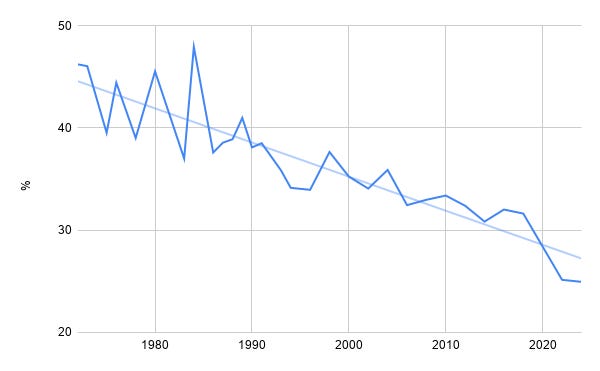
The General Social Survey (GSS) conducted in the United States since 1972 by NORC at the University of Chicago includes a question about interpersonal trust: “Generally speaking, would you say that most people can be trusted or that you can’t be too careful in dealing with people?”4 In the early 1970s, a significantly higher portion of Americans said “most people can be trusted” than do today. Over the decades, the share answering “most people can be trusted” has decreased to under 30%:5
Edelman’s 2026 Trust Barometer suggests where this leaves us: 70% of Americans are now unwilling or hesitant to trust someone who holds different values, believes different facts, or comes from a different background — what Edelman calls an insular trust mindset. The same survey finds the trust gap between high- and low-income Americans is the widest of any country measured, at 29 points, and that 65% worry other countries deliberately contaminate our media with falsehoods to inflame our differences. Edelman surveys online panels rather than probability samples, so its figures are best read as directional — but the direction matches everything above.6
This decline in trust is not a mere statistical curiosity; it has profound real-world implications:
Collective Action and Social Cohesion: When trust erodes, coordinated action — whether in response to crises or in pursuit of shared goals — becomes increasingly complex. A society lacking trust is prone to gridlock, where cooperation gives way to suspicion and fragmentation. When we no longer have a basis for debate, strength becomes the determining factor.
Institutional Functioning: Institutions are designed to mediate conflict, provide services, and uphold the common good. Without trust, these institutions lose their legitimacy, resulting in inefficiency and a diminished ability to address the complex challenges of modern society. The scale at which societies can effectively organize shrinks, as evidenced by the decline in the power of supranational bodies (e.g., the UN, WHO, and the EU) and a resurgence of nationalism.
Polarization and Fragmentation: As trust dwindles, society risks sliding into one of two dangerous trajectories: a low-trust society characterized by pervasive disengagement and social disarray or one marked by extreme polarization that could eventually lead to societal partition or collapse. Historical precedents, such as the breakup of Yugoslavia or the partition of India, remind us of the catastrophic consequences of unchecked societal fragmentation.
Events of the past several years serve as stark reminders of the high stakes involved:
The events of January 6th, 2021, where long-simmering distrust and polarization culminated in a direct attack on democratic institutions.
Incidents such as the attempted assassination of political figures and the high-profile targeting of leaders in major corporations underscore the volatility that accompanies the transition from a high- to a low-trust society.
The aggressive rhetoric and policy decisions of successive administrations have further accelerated the erosion of trust as longstanding institutions are called into question or directly undermined.
The convergence of findings from Gallup, Pew Research Center, GSS, and Edelman paints a sobering picture. This phenomenon transcends isolated failures, reflecting a pervasive crisis destabilizing nearly every major societal structure. The implications are profound, as trust is the foundation of collective action, social cohesion, and the effective functioning of a complex society.
Up Next — Part II: How did we get here?
Gallup, Confidence in U.S. Institutions Remains Near All-Time Low, https://news.gallup.com/poll/712436/confidence-institutions-remains-near-time-low.aspx (accessed September 2, 2026).
Pew Research Center, Public Trust in Government: 1958-2025, https://www.pewresearch.org/politics/2025/12/04/public-trust-in-government-1958-2025/ (accessed September 2, 2026).
Gallup, Supreme Court | Gallup Historical Trends, https://news.gallup.com/poll/4732/supreme-court.aspx (accessed September 2, 2026).
General Social Survey (GSS) is a project of NORC at the University of Chicago, GSS Data Explorer, https://gssdataexplorer.norc.org/variables/441/vshow (accessed September 2, 2026).
The 2024 GSS reads 24.3% (variable TRUST, n=946, weighted). Pew's widely cited 34% for 2023–24 comes from its self-administered Religious Landscape Study, a forced-choice format with no "depends" option; the GSS's own 2024 web arm, in that format, reads 34.8%. The difference lies in how the question is administered, not in a disagreement about the level of trust. This chart uses the interviewer-administered series throughout. Pew reads the period since 2018 as flat; the paper's claim is the fifty-year arc, which Pew's own title — Americans' Declining Trust in Each Other — describes. See NORC at the University of Chicago, General Social Survey 2024 Codebook, Release 3a (NORC, 2025), variable TRUST, https://gss.norc.org/content/dam/gss/get-documentation/pdf/codebook/GSS%202024%20Codebook%20R3a.pdf; Pew Research Center, "Americans' Trust in One Another," May 8, 2025, https://www.pewresearch.org/2025/05/08/americans-trust-in-one-another/.
Edelman Trust Institute, 2026 Edelman Trust Barometer: Global Report (Edelman, January 2026), 17 (insular trust mindset), 7 (income-based trust gap), 13 (foreign disinformation), https://www.edelman.com/trust/2026/trust-barometer.