


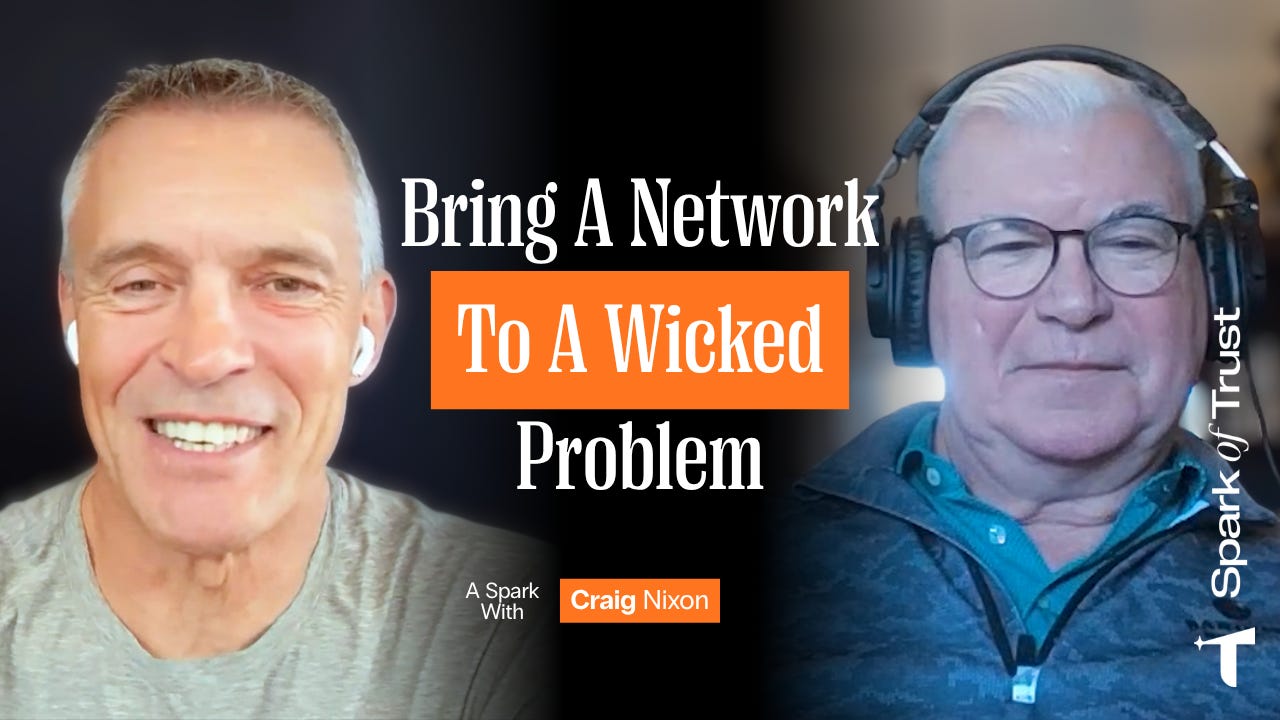
Craig Nixon spent twenty-nine years in the Army, commanded the 75th Ranger Regiment in Afghanistan and Iraq, and helped run the special-operations campaign that Stan McChrystal later turned into the book “Team of Teams.” The argument he carries out of that war is not about raids. It is about problems: the ones too big for any single organization don’t yield to a better hierarchy; they yield when someone links the people already working the pieces. The collapse of trust, he thinks, is one of those problems.
Disclosure: Craig and I co-founded the Trust Foundation together, the nonprofit where this show's work began.
There is a sentence in this episode that most institutions never manage to say about themselves. Craig Nixon says it about the finest strike force his profession had ever produced: “we were operating as better than we had ever operated, and we still weren’t winning, which means we were losing.”
By the early 2000s, he says, the special-operations task force was “probably the best raid force that had ever been assembled at that point,” built over ten or fifteen years. Every input was maxed. The needle wasn’t moving. The enemy was a network; the task force was a hierarchy; and no amount of excellence within the hierarchy could close the gap.
If you are building something serious against a problem that doesn’t care how good you are, you have felt this without the war attached. The numbers inside your walls look fine. The problem outside them isn’t shrinking. More effort produces more output, and no more progress. The task force hit that wall with the best resources on earth behind it: “To use Stan’s line, we couldn’t shoot straighter, we couldn’t fly faster, we couldn’t work any harder. So we just had to do things differently than we had been doing.”
He is a retired Army brigadier general: Panama; Task Force Ranger operations in Somalia and Bosnia; seven deployments to Afghanistan and Iraq; command of the 75th Ranger Regiment in the middle of both wars; and a stretch as Director of Operations at JSOC, during the campaign McChrystal ran and later wrote about. After retiring in 2011, he became a founding partner of McChrystal Group, then the CEO of ACADEMI and Constellis Group, carrying the same argument into rooms full of executives rather than operators. So when he describes what “differently” meant, he is describing something he helped build multiple times1.
Differently meant this: keep doing the work, but change what the work is for. “We still continued to do the kill and capture raids, and that was part of what brought everybody to the table. But the table became more important in a lot of ways than the raids.”
That sentence is the whole thesis in miniature. The raids, the visible output, the thing the organization was built to produce, became the reason the intelligence agencies, the coalition partners, and the interagency showed up. The table is what won: the shared picture, assembled from organizations that had been working the same problem in separate silos. By Craig’s count, the tempo went “from seventeen raids a month to three hundred.” McChrystal’s published version of the same arc runs from roughly eighteen a month in 2004 to three hundred by 20062. Seventeenfold is not what a hierarchy gets from working harder. It is what a network gets when the same people share one picture of the fight and are trusted to act on it.
Craig has a name for the class of problem this applies to. A wicked problem has no clean edges: every piece touches another, no single owner, no finish line. “If you wanna solve a wicked problem, I think the approach of bringing a network against a wicked problem may be the only way to do it.” And then the harder half of the claim: “I don’t think there’s a single organization that’s going to solve the kind of problems that we have. The real art becomes how you link all the disparate organizations that are already doing things at pieces of the problem together in a way that enables what they’re doing, enables what you’re doing, and ultimately has a cumulative effect of getting to the tipping point of solving the problem.”
Read that a second time with the war stripped out. The art is not building the winning organization. The art is the linking.
Which is exactly how he reads the collapse of trust. After three years of looking at the people trying to repair it, in our work at The Trust Foundation, the assessment is generous and brutal in the same breath: “There are lots of people doing lots of great things. Individually, I’m not convinced any of them will be successful. In fact, I’m pretty well convinced individually none of them will be.” Not because the work is bad. Because the problem is wicked, and each effort is a raid force: excellent, and alone.
If you build things, this is where the essay turns toward you. Maybe you walked away from a model you stopped believing in, an attention machine, an extraction machine, and you are building something people can trust instead. The uncomfortable arithmetic is that the problem you picked is almost certainly bigger than the organization you are building to meet it. Craig’s evidence says that is not a reason to stop. It is a reason to change what winning means: from being the answer to being linkable. Someone is already working the piece of your problem you can’t reach. Your output, like the raids, may matter most as the thing that earns you a seat at their table.
What holds a linked thing together has names, and Craig borrows them honestly from the book before adding his own word. “Shared consciousness and purpose at the higher level, empowered execution at the lower level,” he says, quoting the “Team of Teams” frame, and then: “and I would add, and trust.”3 His definition of it is operational, not sentimental: “people do what they say they’re gonna do, regardless of the danger involved.” (In his old world it came with a tolerance: a pilot who commits to 0300 arrives “plus or minus 15 seconds.”)
And it has to run both ways to work. Downward, as underwriting. Craig speaks both sides of that deal in one breath: the operator trusting that “my boss at the other end of that will understand I am in the intent of trying to accomplish the mission,” and the boss whose answer is “I will underwrite those type of mistakes.” Upward, as confidence: “If I don’t trust that you’re gonna be there when I look over my shoulder… then I’m going to half step or hedge my bets at the lower level. So the speed of execution is always gonna slow down.” The half step is what a network dies of. Nobody quits. Everybody hedges.
Now the awkward part, because Craig puts it on the table himself. Networks are not assembled on neutral ground. “It’s not a blank sheet of paper.” The field is already occupied by industrial-era hierarchies “mainly fighting for their survival,” and some of them will read your network as a threat, correctly: “there are organizations out there that not only won’t help you, but are actively fighting against you because you are now threatening their organization or institution.”
And even the people who should join don’t arrive humble. “The old line is if you wanna get a message out to special operators, just write it on a mirror.” The network that turned the war was not built by people free of ego. It worked because three specific things were true, and Craig lists them without romance. There was a strategic leader with the vision and the drive, and “Stan was that guy.” There was a core of prior trust decades in the making: “the Delta commander and the SEAL Team Six commander and myself were all good friends, and all served together over a long period of time.” And there was success as a convening force, the pull of “they’re doing something over there that we want to be part of.”
That is the bill, itemized: a leader, a trusted core, and visible results. Most people starting on a wicked problem have none of the three, and the early years of building them look like loss. You keep doing your raids, you give away your picture of the problem, and you sit at tables where the credit is dispersed. The trust numbers say how long the road is. In Gallup’s June 2026 poll, two American institutions still hold majority confidence: small business at 67 percent and the military at 61, one point above the low it touched in 2023, its worst reading since 1997. Everything else is underwater, and average confidence across the fourteen core institutions has now sat below 30 percent for five straight years4.
One spark, then, and it is a link, not a plan. Somewhere, someone is already working on a piece of the problem you care about, probably in a domain you don’t read. This week, send one of them one message: what you are seeing from your piece, and what you could carry for theirs. No pitch, no ask, no tool, no budget. Extend first, the way Craig does: “I will extend trust to you until you show me that you don’t deserve trust.” Then do the one thing that keeps a network alive once it exists, which is also his floor for the whole project: “do the things that you say you’re gonna do… if you say you’re gonna do it, do it.”
The full conversation holds more than this essay can carry: Sarajevo going from Olympic host to chaos within a decade, how he rebuilt the Rangers’ whole way of operating mid-war, and the rule he now uses to decide which work he will join. And near the end, he offers the closest thing to hope the hour contains. Inside a network, the gains compound where you can see them. Outside it, they compound where you can’t: “geometric improvement external to the network that you may never know about. It may be the silver bullet that solves trust.”
Until next time, keep being the spark that ignites the Trust Revolution.
Career facts: Washington Post, December 6, 2004 (identifying Col. James C. Nixon as commander, 75th Ranger Regiment); ACADEMI press release, February 28, 2013 (CEO appointment); Ranger Hall of Fame biography, ranger.org (https://ranger.org/wp-content/uploads/2021/02/Craig-Nixon-Bio-.pdf). The JSOC Director of Operations role, per his official biography and direct knowledge, is not listed in any independent public source.
Stanley A. McChrystal, "It Takes a Network," Foreign Policy, February 21, 2011, https://foreignpolicy.com/2011/02/21/it-takes-a-network/; and Stanley McChrystal, Tantum Collins, David Silverman, and Chris Fussell, Team of Teams: New Rules of Engagement for a Complex World (New York: Portfolio, 2015). The published figures run from roughly 18 raids per month (August 2004) to roughly 300 (August 2006); the in-essay count is Craig's, from the episode.
McChrystal et al., Team of Teams (see note 2).
Lydia Saad, "Confidence in U.S. Institutions Remains Near All-Time Low," Gallup, July 14, 2026, https://news.gallup.com/poll/712436/confidence-institutions-remains-near-time-low.aspx (survey June 1–15, 2026: small business 67% and the military 61% are the only majority-confidence institutions; 14-institution average 27%, a fifth consecutive year below 30%). For the military, 2023 saw a low of 60%, its lowest since 1997: Gallup, "Historically Low Faith in U.S. Institutions Continues," July 2023, https://news.gallup.com/poll/508169/historically-low-faith-institutions-continues.aspx.